



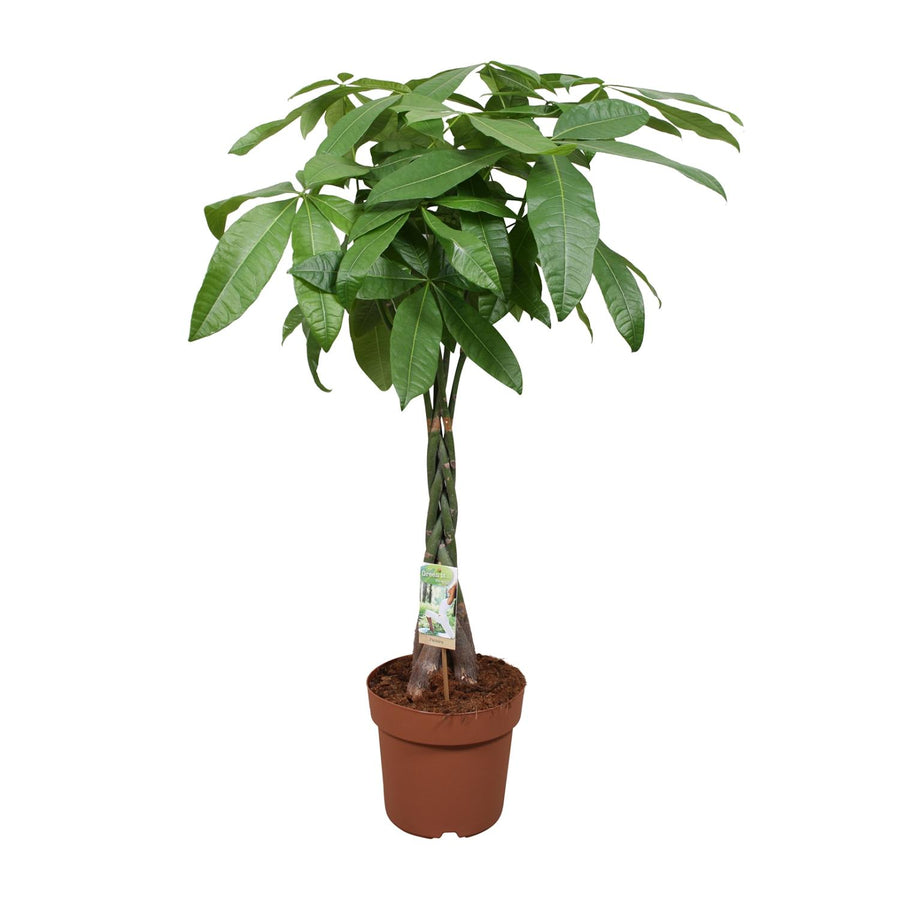
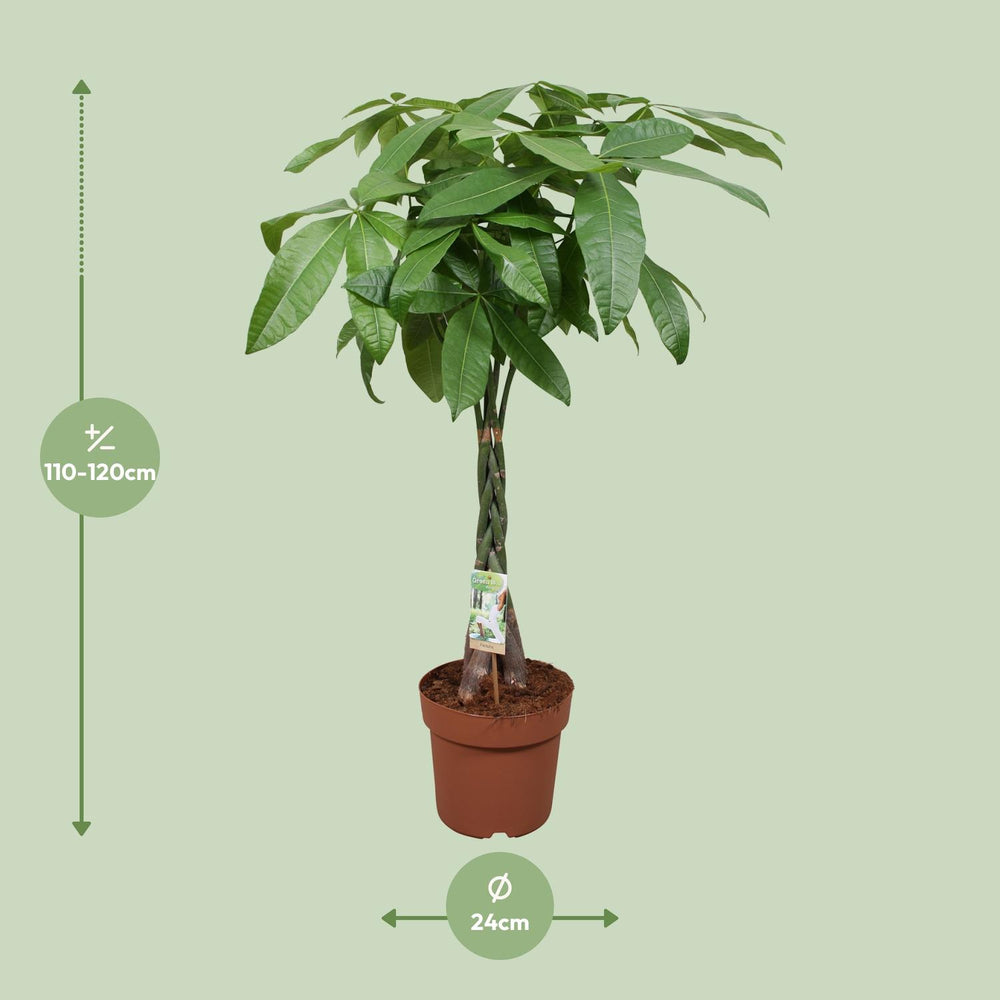
The money tree (Pachira aquatica) is a houseplant with a braided, bottle-shaped trunk and fans of bright green, hand-shaped leaves. It is traditionally given as a good-luck gift and copes well with normal indoor conditions. The range runs from 45 cm tabletop plants to 120 cm floor plants. Free delivery to 25 EU countries, usually 5–8 working days.


Which money tree should you choose?
| Plant | Look and size | Good for |
|---|---|---|
| Tabletop money tree | About 45 to 55 cm, braided trunks in 12 to 17 cm pots, singles or sets of two | Desks, shelves and gifts |
| Medium money tree | About 70 to 110 cm in 19 to 21 cm pots, some supplied with a basket | Sideboards and living rooms |
| Large money tree | About 120 cm with a braided trunk | A floor-standing statement plant |
Stock changes through the year; this page lists only the lines available now.
Where do money trees grow best?
Money trees grow best in bright, indirect light and tolerate some morning sun. They cope with lower light but grow slowly and lose leaves if it is too dark. Keep them away from draughts and radiators. For other bright-room choices, see our low-maintenance indoor plants.
How do you care for a money tree?
Water when the top 3 to 5 cm of compost is dry, roughly every one to two weeks in summer and less in winter, and always let excess water drain away. A money tree stores water in its trunk, so overwatering is a bigger risk than missing a watering: yellowing, dropping leaves and a soft trunk base mean the roots are too wet. Keep it above about 12 °C.
Is a money tree the same as a Chinese money plant?
No. The money tree is Pachira aquatica, a braided-trunk tree. The Chinese money plant is Pilea peperomioides, a small plant with round, coin-shaped leaves.
Frequently asked questions
Why is my money tree dropping leaves?
Leaf drop usually follows overwatering, a cold draught or a sudden move. Check that the compost is not soggy and keep it in a steady, bright spot.
How big do money trees grow?
Indoors they usually reach 1 to 2 metres over several years; the braided trunk thickens slowly.
Why is the trunk braided?
Several young stems are plaited together while they are flexible, then grow into one thick trunk.
More houseplants: indoor plants, easy care plants, large indoor plants.